Wild Rice the Native Way
"Thank you spirit that again we come to see this wild
rice that you have offered to the Indian for him to eat."
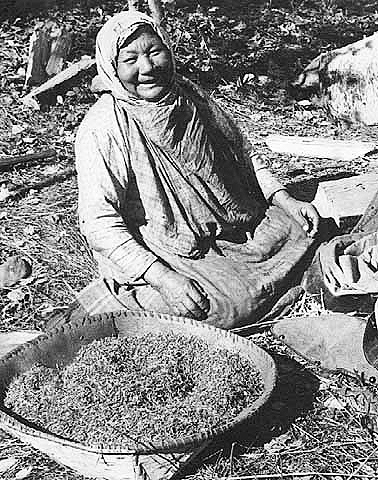
Native Americans and the French in the New World.
Gordon R. Sommers photo, Minnesota Historical Society (CIRCA 1940).
"Manoomin" is the Ojibwe Indian name for wild rice, the only cereal grain native to North America. The popular interpretation of manoomin is "good berry" or "good seed". According to historians, the seed from this plant has been harvested from natural stands and used as food for some 10,000 years.
"Manoominikewin" (muh no mee nee KAY ween) is an Ojibwe word that means harvesting wild rice. Wild rice has been a part of Indian life for thousands of years in the land we now know as Minnesota. To many of the Indian population in this region, manoomin is a food rooted in tradition, with the wild rice harvest being a vital part of their Indian culture.
Wild rice continues to grow, as it has for many thousands of years, along the edges of shallow lakes and slow-moving streams in northern Minnesota and southern Canada. The large proportion of wild rice grown on Indian reservations today, relative to their area, is not surprising. In negotiating reservation boundaries, Indians requested that the wild rice beds be included since wild rice is a staple Indian foodstuff.
Living By The Seasons
When you live by the seasons, you gather, eat, and use what nature provides. You move when you need to - living in the forest each winter, perhaps, or moving to a lake each summer. Your life has a special rhythm, in time with the natural world. Before the Europeans came, all the Indian peoples in the wild rice region lived by this rhythm.
Wild rice was among the first items traded by the Indians and the French in the New World. Some trace the reputation of wild rice as a gourmet food to those early days when the voyagers sent back wild rice samples to Europe, where they were well received. This trading involved only small amounts of the grain while most of the harvest continued to be consumed by the Indians.
Does Anyone Still Live By The Seasons?
Many Indian people still live by the seasons. For some, it's a means of survival, for others, it's a way of keeping valued tradition. They may use guns to hunt, nylon nets to fish and plastic bags to collect maple sap, but the seasonal rhythms and the reliance on the gifts of nature remain the same as in the days of their ancestors.
Even today, hand harvesting on all Minnesota waters is, by law, restricted to the traditional canoe & flail method.
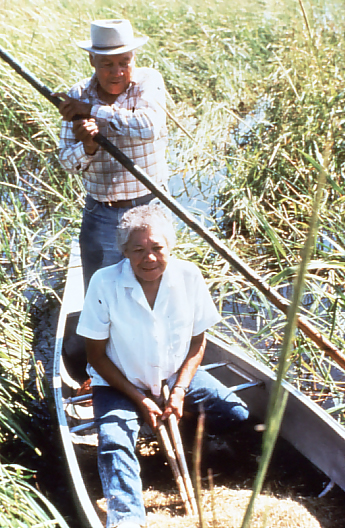
Hand Harvesting - This process requires two individuals. One crouches in the bow of the canoe, or other narrow boat, and gently taps ripe kernels into the canoe with knocking sticks called "bawa'iganaakoog" (bah wah eegah NAH koog) which are made of lightweight cedar. The other stands in the stern and propels the canoe using a long pole. The kernels that fall outside the canoe seed the area for future harvest. Harvesting in this manner is labor intensive, but is still a tradition in many Indian families.
What Happened in Ricing Camps?
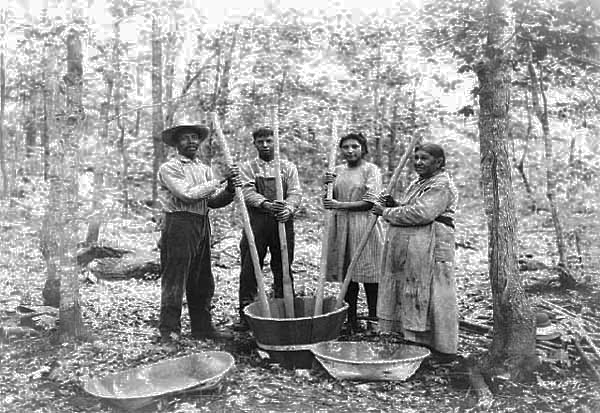
The harvest lasted nearly a month with different tasks assigned to men, women, and children. Both men and women knocked rice, although it is said that a long time ago knocking was women's work. Thrashing, or jigging, requires stamina and a light step and was most often done by the boys and young men. Winnowing was typically the job of skilled, older women.
After the wild rice is gathered, the basic processing steps of wild rice are the same as they have been for a thousand years, essentially unchanged from the traditional Indian method of parching, thrashing, and winnowing. Parching was traditionally done over open fires, thrashing was done by "jigging" or dancing on the wild rice to remove the hulls, and winnowing was accomplished by tossing the wild rice into the air from a birch tray, allowing the wind to clean the debris from the wild rice. Today mechanization has taken over and finishing plants do the processing of most hand harvested wild rice.
Traditional Processing Steps
Parching - drying of the moist wild rice kernels. Wild rice can be stored for years but first it must be parched. To parch wild rice, several handfuls are placed in a kettle or "okaadakik" (oh KAH duh kik) over a hot fire. The wild rice is stirred with a wooden paddle to prevent scorching.
Thrashing - removing the hulls from parched wild rice by "jigging" or dancing to separate the hulls from the parched wild rice. The wild rice is then poured, a little at a time, into a wooden "bootaagan" (boe TAH gun). Typically, a young man, wearing clean moccasins, treads lightly on the wild rice crushing the brittle hulls with his feet.
Winnowing - separating the wild rice kernels from the hull. As the wild rice is tossed from a birch bark tray called a "nooshkaachinaagan" (noosh KAH chee NAH gun), the wind blows away the broken bits of hull leaving the kernels in the tray.
What Became of Wild Ricing Camps?
By the 1940's, as more people acquired cars, day trips to wild rice lakes became common. Although some people still camp during ricing season, it's no longer a necessary part of the harvest.
The Land Changes Hands
When the only inhabitants of the region were Indian people, the land and its resources were held in common. Necessity and tradition governed how the land was used. The Europeans, however, arrived with different ideas about land ownership. Before long, these new Americans carved the land into farms, logging camps, mines, and Indian reservations. Along with these changes came changes in wild ricing.
Today, three Indian reservations in Minnesota have substantial wild rice stands, and several others in Minnesota and surrounding states have smaller stands. Harvesting regulations are set by the various Indian groups and vary slightly from one reservation to another. Only Indians, and non-Indians living on the reservations, are ordinarily allowed to harvest in reservation waters.
Native American Quotes
"It's not just food for the belly, but food for the head. We are doing something our ancestors did and we are doing it the same way!"
"There's a feeling you get out there that's hard to get other places. You're closer to mother nature. Seeing things grow and harvesting the results of the water and sun and winds. We sort of touch our roots when we're among the rice plants."
"We were taught to put tobacco in the water before going out to rice, before swimming, before taking bark, roots and herbs for medicine. This is our way of thanking the Great Spirit for providing these necessities."
Information in this section was provided by:
Manitok Wild Rice,
White Earth Reservation,
University of Minnesota and the Minnesota Historical Society.